|
Eager Space | Videos by Alpha | Videos by Date | All Video Text | Support | Community | About |
|---|

Welcome to eager space...
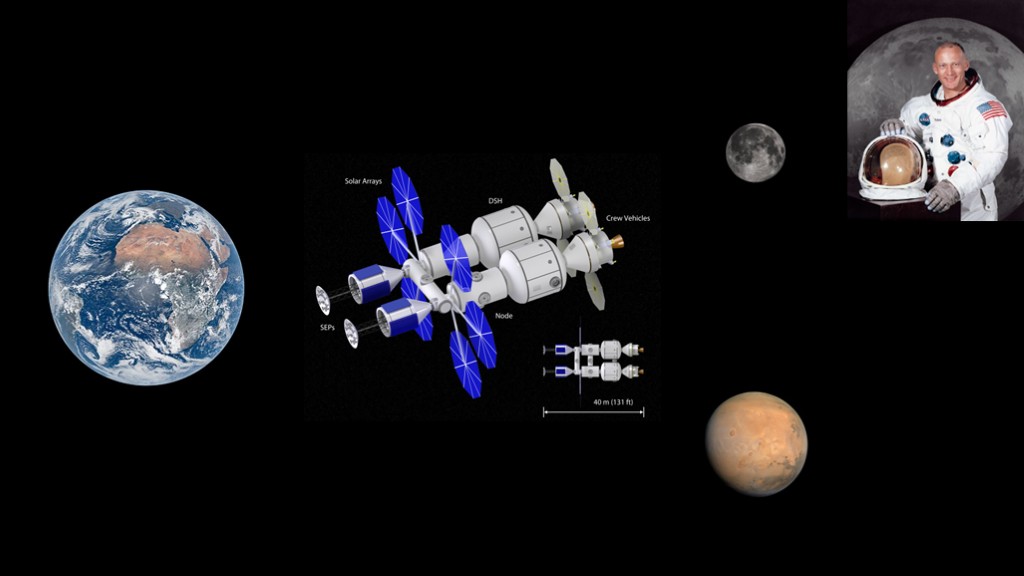
A cycler is a concept intended to make trips between celestial bodies - typically the earth and moon or the earth and mars - safer and cheaper.
I've always said that astronauts are very good sports. The apollo astronauts spent three days crammed into a tiny capsule on their way to the moon, and another three days on the way back. Not much room and not much protection from the hazards of space, such as radiation.
The current Artemis program's Orion capsule is roomier but it's still fairly small and cramped.
What do you want for your trip to the moon - a bare bones capsule, or something more like a space bus with more room and more amenities.
Big spacecraft are very expensive, so what you need is a reusable space bus.
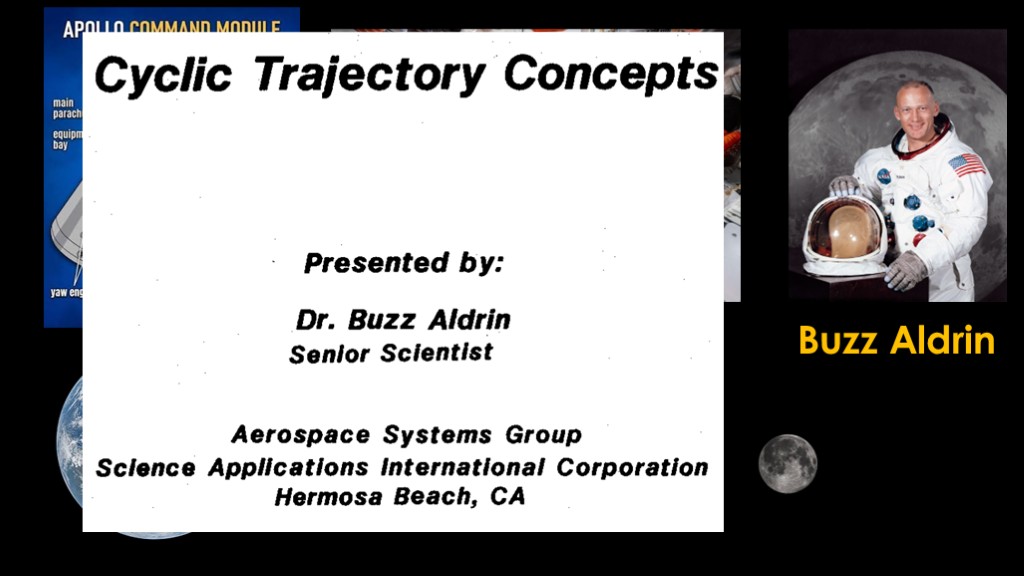
That is the point of the cycler architecture, invented - or at least formalized in 1985 - by this guy that you might have heard of...
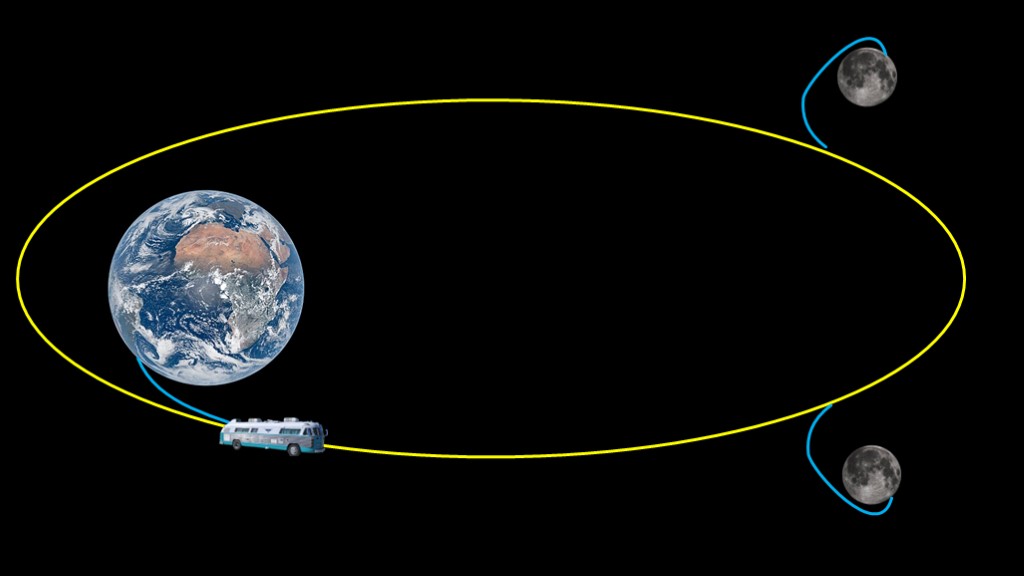
Here's the basic idea.
You launch your bus into an elliptical orbit that goes around the earth and out to the moon.
You launch from the ground to meet up with the bus when it's near the earth. You then stay on the bus until you get close to the moon, and you hop off and land on the moon using a short-range lander.
The return trip is pretty much the same, except you likely hop on when the bus is heading home rather than when it's heading out.
That sounds great. You get a nicer environment for your trip, and you can bring along new modules to expand your living space each trip. Over time, you can build what Aldrin called a "space castle".
These orbits are stable enough that the bus only requires a little propellant to stay in the orbit.
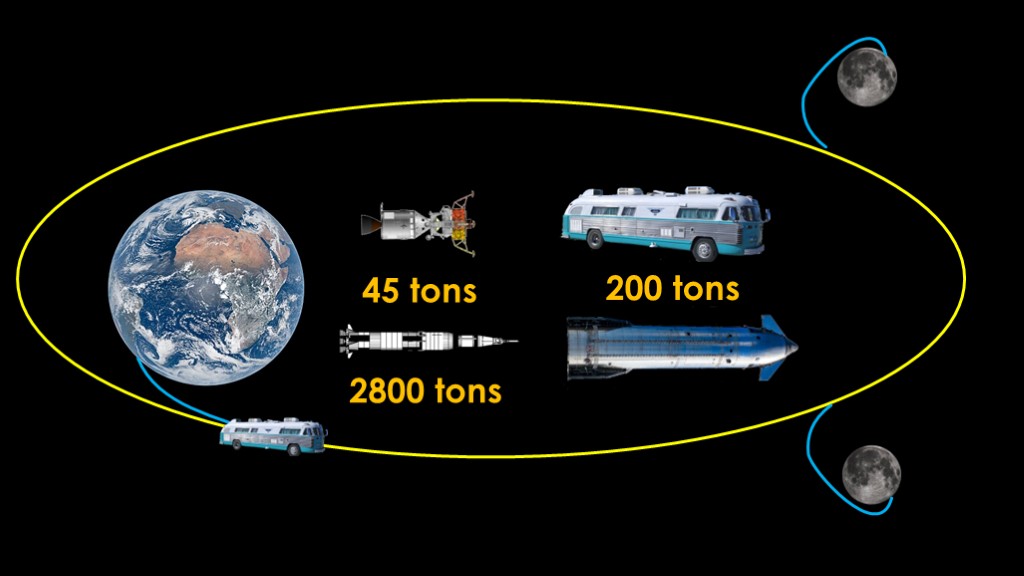
There are a few issues...
The first is the size of the bus. The Apollo spacecraft massed about 45 tons, and to send that to a moon required a launch vehicle of about 2800 tons.
If we assume that our bus is 200 tons, then we need a rocket 4 times the size of the Saturn V. You might get 2-3 times the performance with a fully expended Starship, but if you want to go bigger you really need a refueled starship.
This is one of the reasons that lunar cyclers haven't gotten much interest - a vehicle that takes 2-4 Saturn Vs to launch hasn't been practical or affordable.
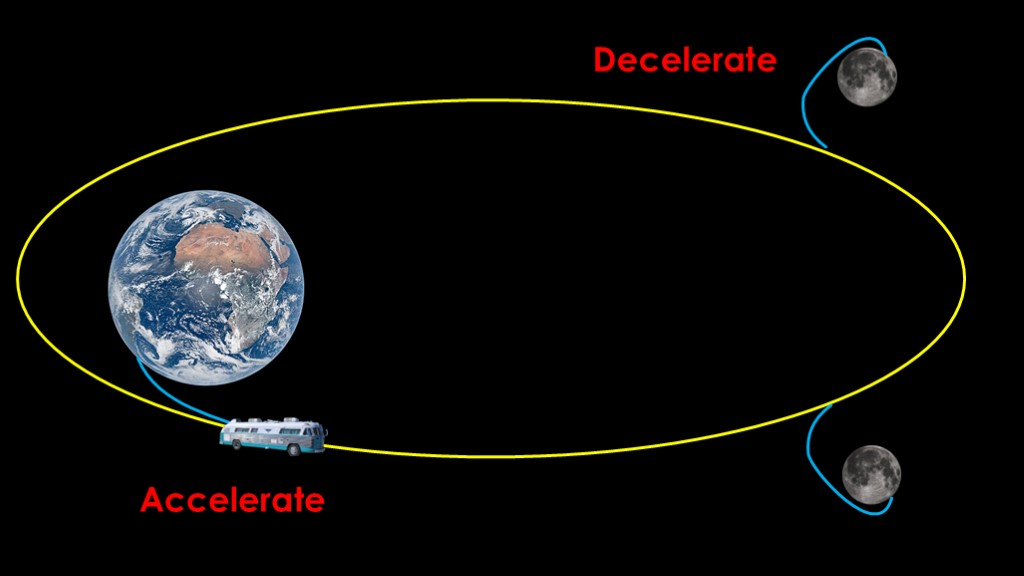
A second issue is related to the biggest misconception about cyclers. They do not take you from earth orbit to lunar orbit or vice versa. The bus does not orbit either body, it flies by them.
From the earth surface - or low earth orbit - you need to chase after the bus to catch it. The bus is travelling roughly the speed that it takes any spacecraft to get to the moon - perhaps a little bit faster. You then ride the bus to the moon, but instead of just barely reaching the moon so you can easily get into orbit, the cycler has some velocity as it goes and you therefore need some extra propellant to get into orbit.
That means the energy to get to the moon using a cycler is roughly the same as it would take if you follow the Apollo approach. You just stay in a nicer room for the trip.
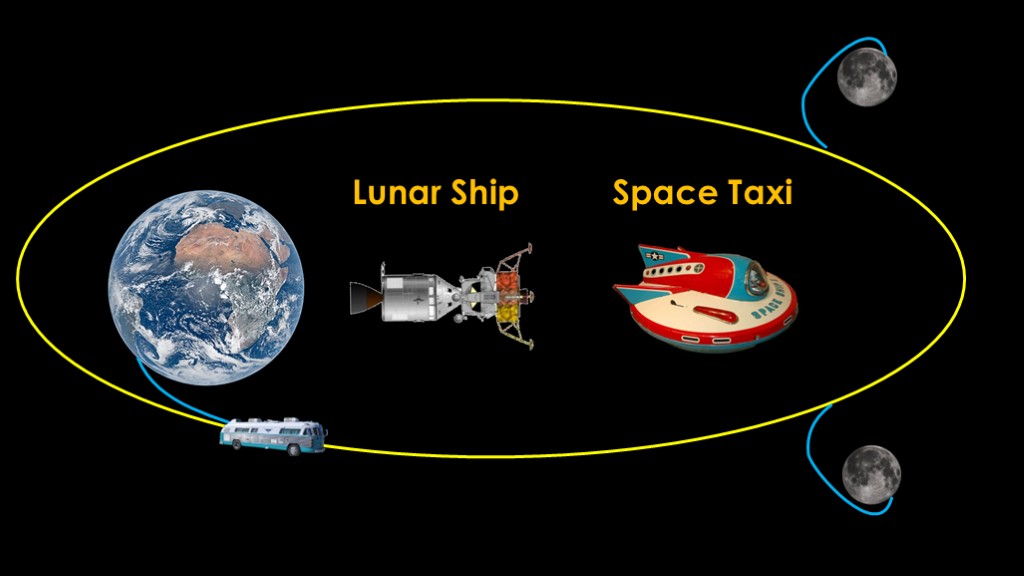
So why bother?
Well, the hope is that instead of using a high performance and very expensive lunar ship, you could instead use some sort of space taxi to get you to the cycler and then from the cycler to the moon.
The space taxi doesn't have to support you the whole time and therefore it can be cheaper and simpler, and that might make the overall system cheaper in the long run.
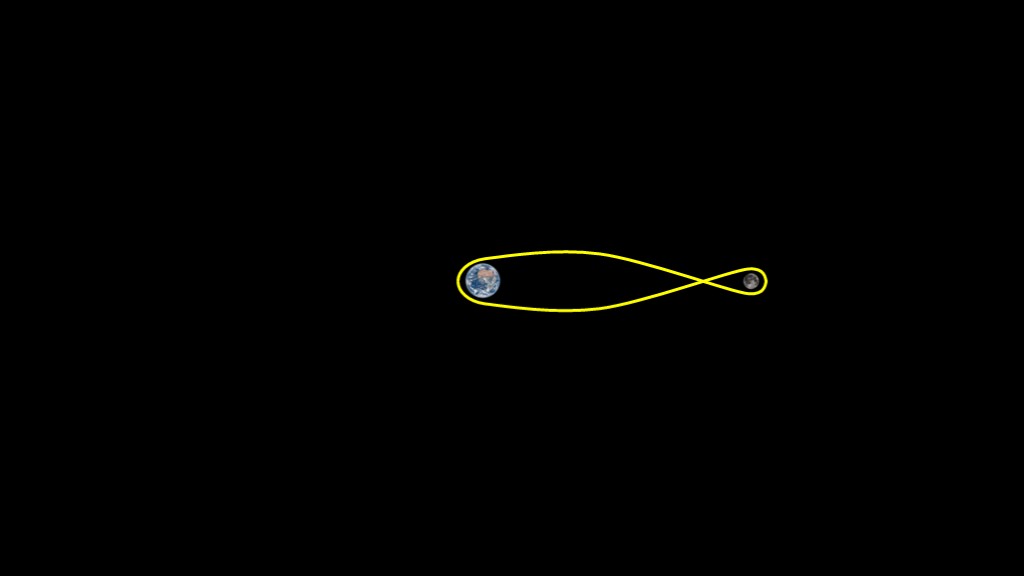
The orbital mechanics is more complex than I showed.
We set up the orbit of our bus so that it goes out to the moon and loops around it to drop people and cargo off, and then it returns back to earth. After going around the earth it takes the same trip, over and over.
But the moon isn't just stagnant in space, it is orbiting the earth, and by the time our bus is leaving the earth again, the moon has rotated around the earth so it's not anywhere near the orbit of our bus.
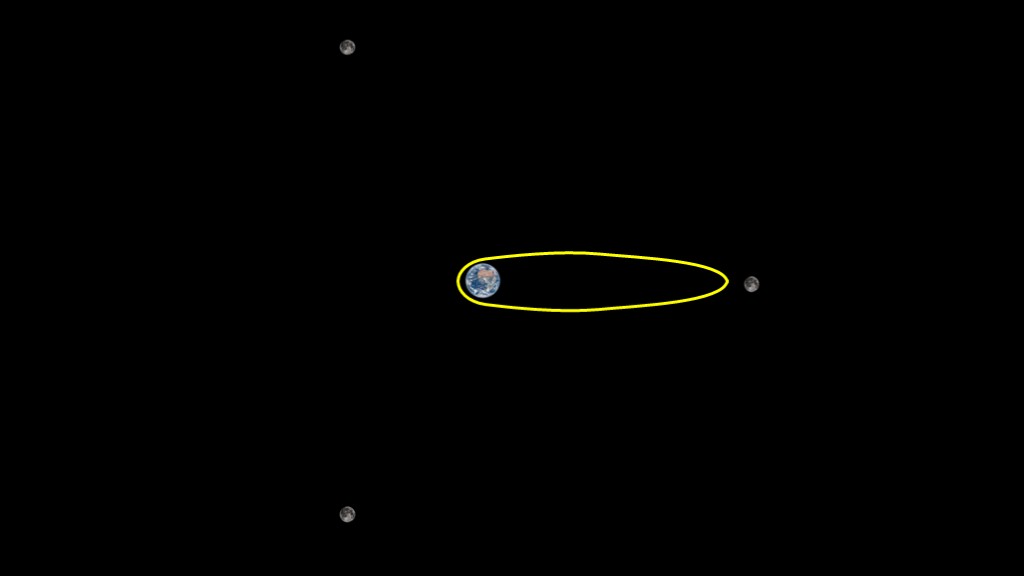
That means that our next bus trip doesn't go anywhere useful - it just goes out to around the lunar orbit distance and comes back.
Then the next trip the moon has continued its orbit but isn't close to the original position.
And then finally - if we set up our orbits properly - the moon returns to the original position relative to the bus orbit, and we can visit again.
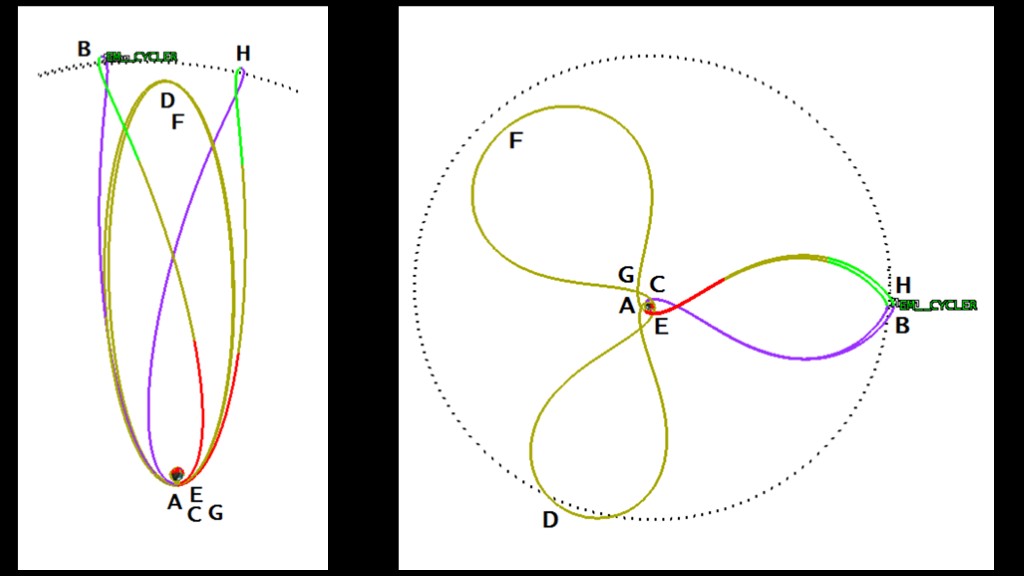
Here are two nice plots. In the left one, the earth and the bus orbit are kept stable, and we can see that the ABC orbit visits the moon but the CDE and EFG orbits do not.
The pretty one on the right is from the moon's perspective - the ABC trip goes out and around the moon and then the CDE and EFG ones are quite out of the way because the moon has moved.
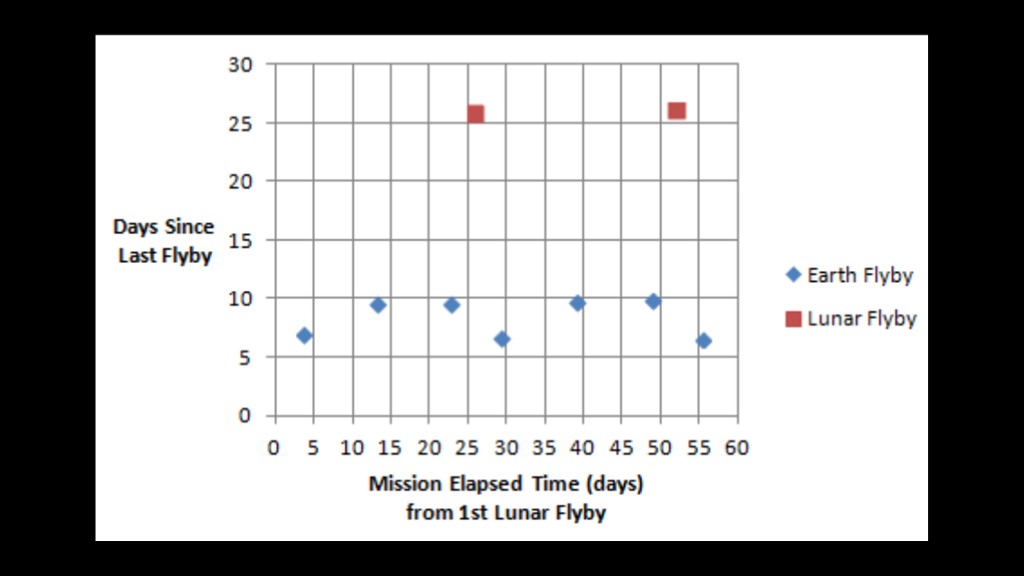
A cycler therefore has limited travel opportunities
Here's a chart that shows the times - the bus gets to visit the moon roughly every 26 days with two trips to nowhere in between the lunar visits.
This shows that the lunar cycler will get you to the moon and then you need to wait nearly a month before it swings by to take you home. Like a bus, it gets you where you want to go but the timing may not be as convenient as you hoped.
One can, of course, launch as many of these cyclers as you want in different orbits, and there are other possible lunar cycler orbits that can be used.
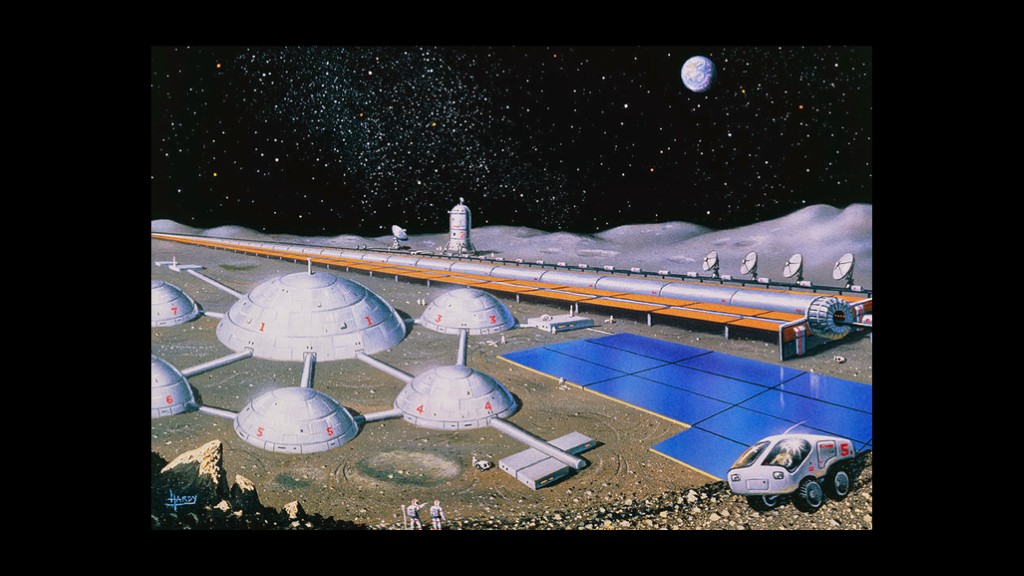
For the moon, I think cyclers only start getting interesting when you have moved beyond the lunar base to a settlement or colony. In those scenarios, dedicated earth to cycler spacecraft and cycler to moon spacecraft make sense.
We are, of course, a long way from that right now.
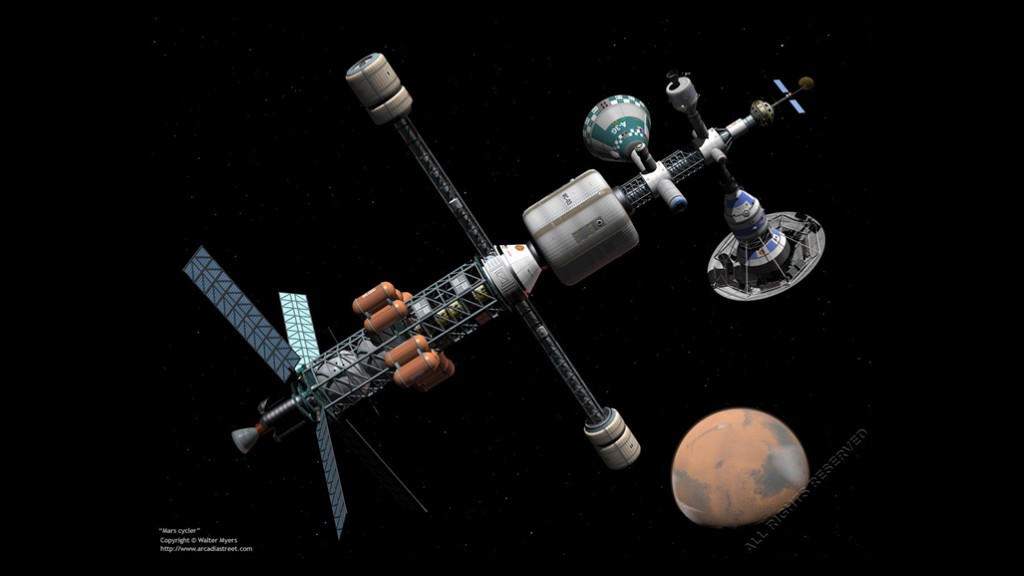
But it's Mars cyclers that are more interesting...
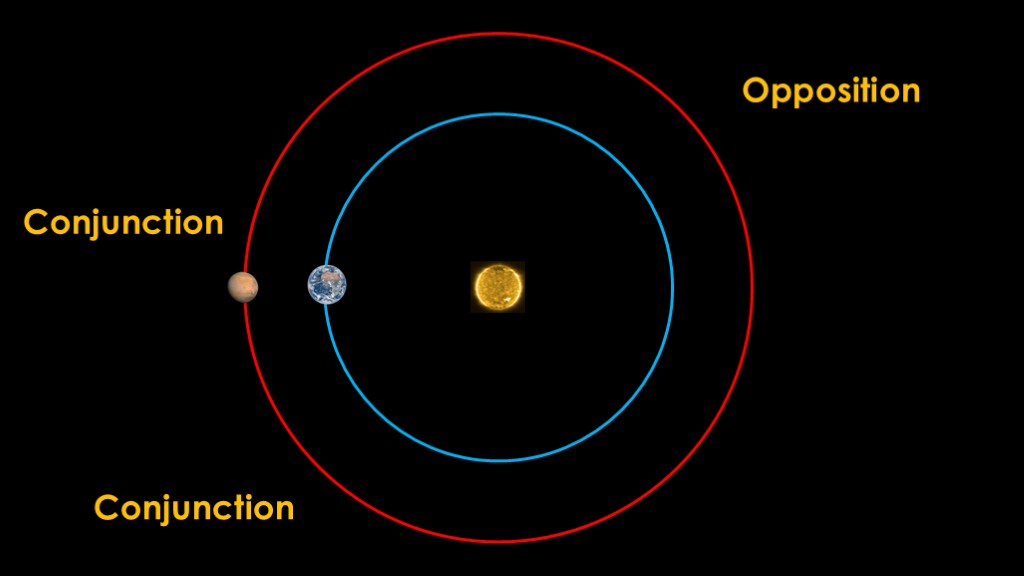
To understand them , we need to understand a bit about orbital dynamics.
The earth and mars both orbit the sun, with an orbit of the earth taking a year and an orbit of mars taking about 1.9 years.
When the planets at their closest point to each other, it's known as conjunction. Because the earth orbits more quickly, it will get ahead of Mars until they are opposite each other, a position known as opposition.
Eventually the earth will catch up at the next conjunction, about 26 months after the first one.
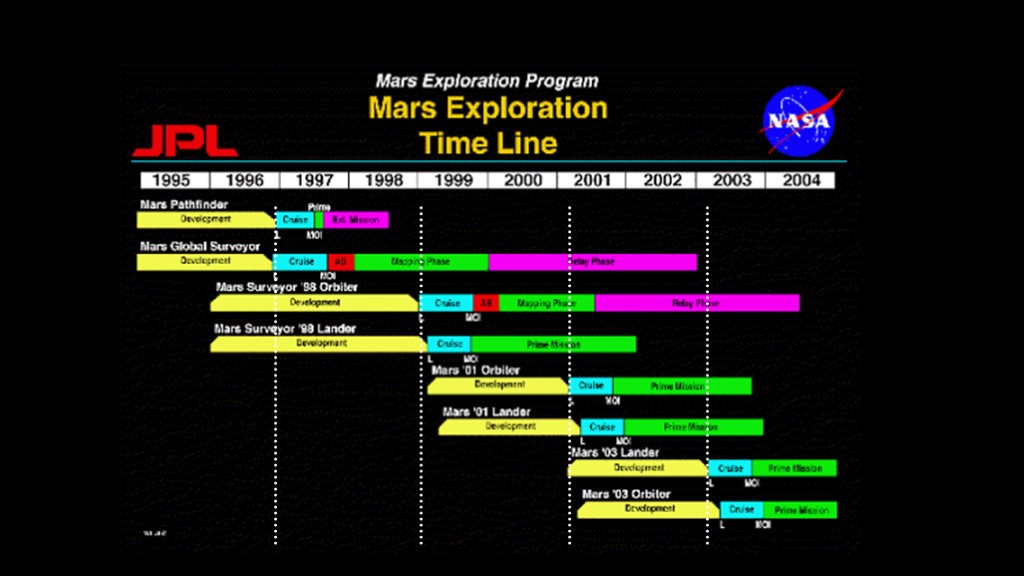
This cadence shows up in science missions - roughly every 26 months there is an opportunity for new missions to head to mars.
It is possible to travel to Mars at other times, but it's much more expensive in terms of propellant use and that means a heavy payload penalty.
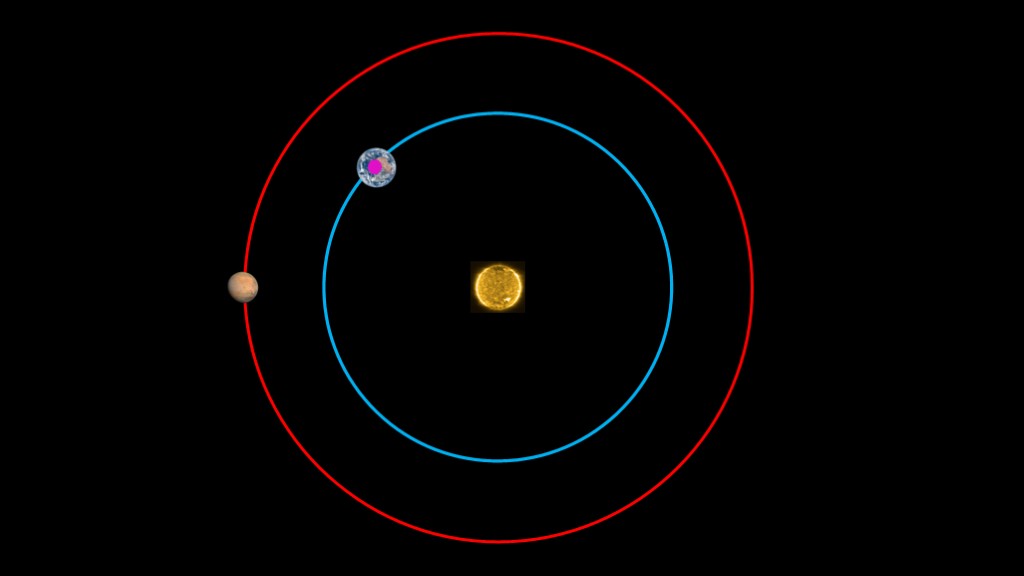
Saying it's at conjunction isn't precisely true...
Heading from the earth to the mars, we launch about 44 degrees before conjunction for the most energy-efficient transfer, with the mars encounter happening after conjunction.
Our spacecraft will chase after mars and eventually catch up with it because it is travelling faster than Mars.
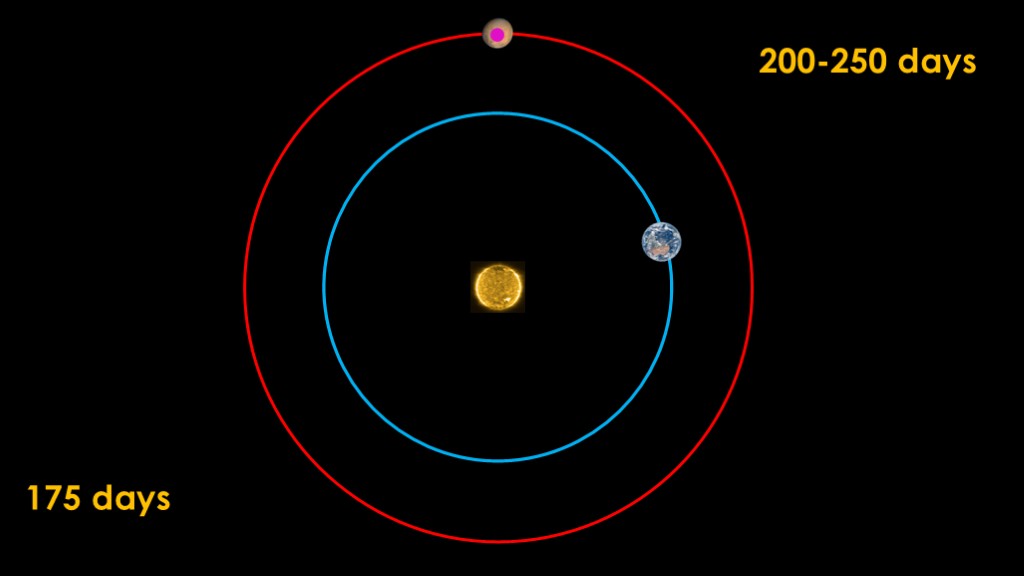
Coming back from Mars, we need to launch when earth is roughly 75 degrees behind mars so that we will get to earth orbit when the faster earth gets there.
In both cases, the journey will take 200-250 days if we choose the most energy-efficient trajectory.
If we are willing to choose a less energy-efficient trajectory, we can get there more quickly - say 175 days - but we end up with less payload because of the extra energy required to do the transfer more quickly.
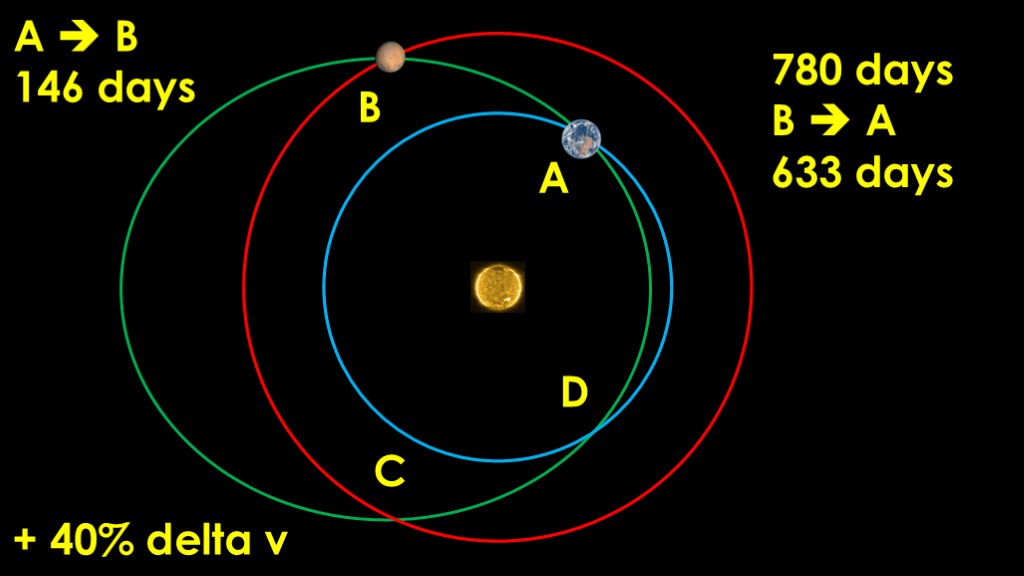
The mars cycler has an orbit that dips inside of earth's orbit and travels beyond Mar's orbit. The orbital path is chosen so that the orbital period is the same as the time between conjunctions, so we know that every cycle, we can launch from earth to meet the cycler at point A and then hop off when the cycle and Mars reach point B.
The cycler travels quickly, and you get there in about 146 days. About 17% faster.
There is, of course, no free lunch. You need to catch up with the cycler and it's going faster than the earth, and that typically requires roughly 40% more delta v to perform the catch, which means you need a more capable vehicle. You also arrive at Mars with more speed that you will need to get rid of to go into orbit or land.
Coming back, you hop on the cycler when mars is at point C and hop off when you reach the earth at point D.
But... that doesn't actually work. Remember that you only get the proper alignment between the cycler and the planets every 26 months. That means that the cycler isn't there when Mars get to point C.
For the return journey, your only choice is to spend a full cycle - 780 days on mars - and then hop on the next cycler at point B, and then spent 633 days waiting for the next encounter at point A. That's 21 months, most of it spent in interplanetary space well beyond the orbit of Mars.
This cycler is optimized to reduce the time spent on travelling from the earth to mars but using it to come home is a very slow trip.
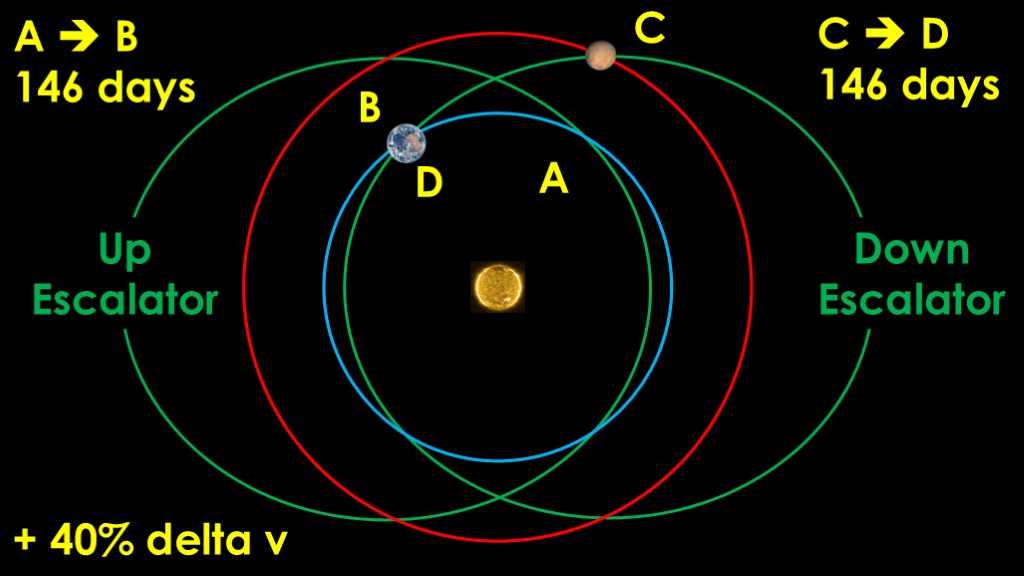
What we need a *second* cycler built to optimize the travel time from Mars to Earth. It crosses the path of Mars and point C and then the path of earth at point D.
With the second cycle, we can do that trip home in the same 146 days.
Aldrin called these two cyclers the "up escalator" and the "down escalator".
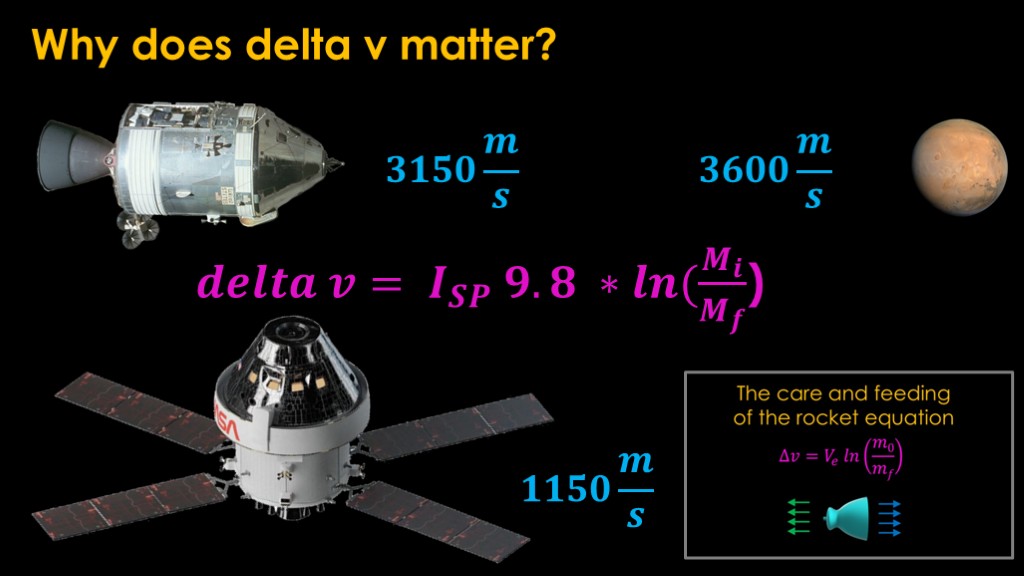
I said that chasing the cyclers requiring 40% more delta V than a direct trip to mars. How does that affect our mission architecture?
It helps to look at an example, and I've chosen the Apollo Command and service module.
We can calculate the delta v of a spacecraft using the rocket equation, which says we take the specific impulse of the engine, multiply it by 9.8, and multiply the result by the natural log of initial mass of the vehicle divided by the final mass when we've used all of our propellant.
If you want the whole story on the rocket equation, see my video "the care and feeding of the rocket equation".
Plug the numbers in for the apollo CSM, and we get about 3150 meters per second of delta v. That is surprisingly close to the 3600 meter per second it takes to get to mars. That's the right sort of vehicle to us as a taxi.
And since I know somebody is wondering why I didn't choose the much newer and more modern Orion capsule, the Orion capsule is a bit of a pig that has close to twice the mass of the Apollo capsule and the service module doesn't carry much fuel. Plug Orion's number into the rocket equation, and we get about 1150 meters per second of delta v.
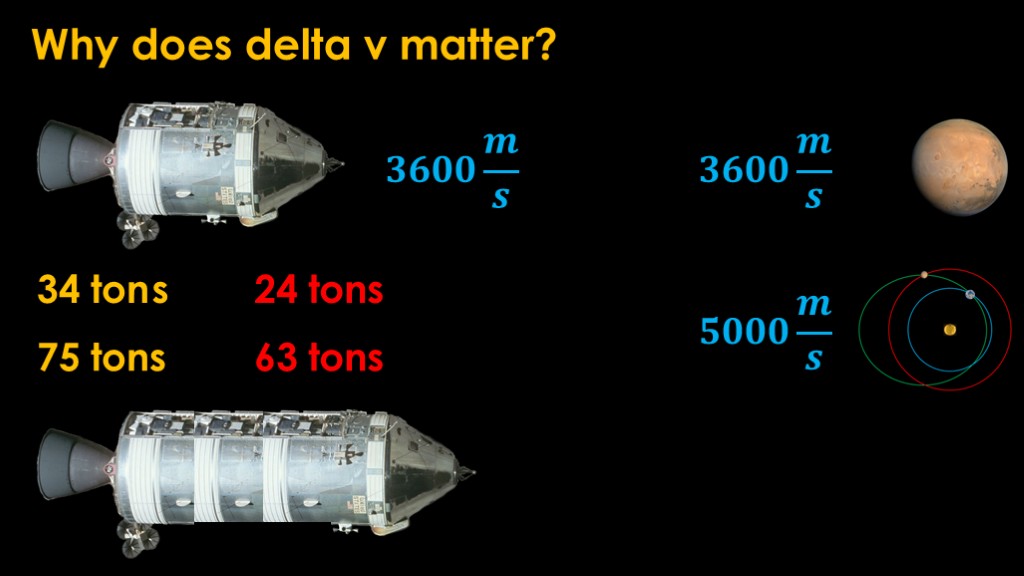
I'll start by modifying the Apollo CSM to generate enough delta v to get to mars. That bumps us up to a 34 ton vehicle with 24 tons of propellant.
The Aldrin cycler takes about 5000 meter per second from low earth orbit.
We will need to modify our vehicle quite a bit to get there. To get 5000 meter per second of delta v, we will need about 63 tons of fuel carried in a bigger and heavier vehicle for a total mass of about 75 tons.
It might look a little like this.
To get 40 % more delta v required a little more than twice the vehicle mass. The idea of cycler is to use a small and simple taxi, but the high delta v requirements requires a big and heavy taxi and a big rocket to launch it.
And remember that there is a separate launch or two to get the cyclers into their orbits.
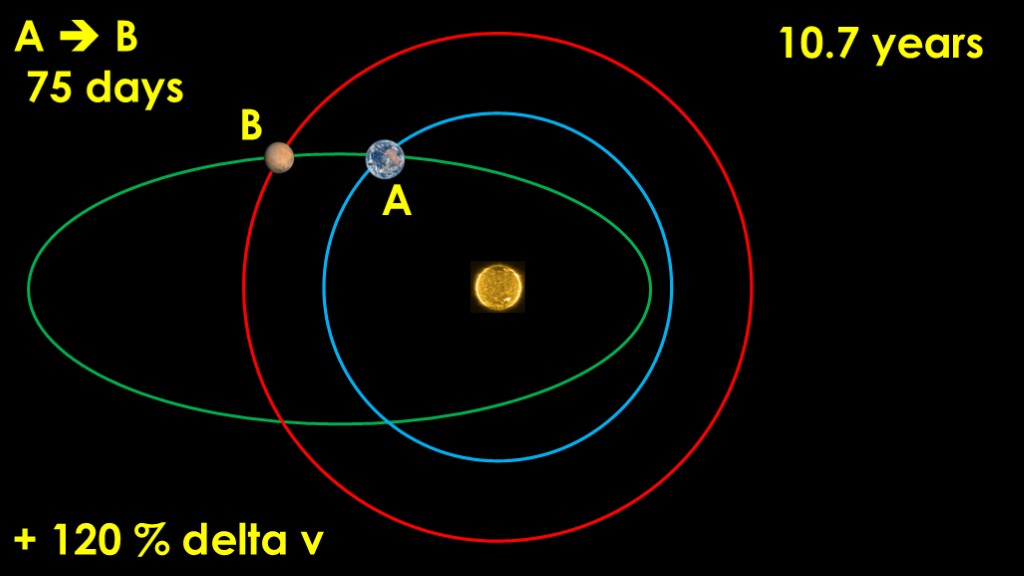
The aldrin cycler orbit is designed to do one orbit every cycle. There are many other cyclers that relax that requirement.
There's one that cuts the travel time down to only 75 days, which is very quick. The downsides are that it requires 120% more delta v to catch it as it goes by earth and has about 30% more velocity at Mars. Oh, and it only shows up every 5 cycles, or every 10.7 years.
But it does get you there really quickly.
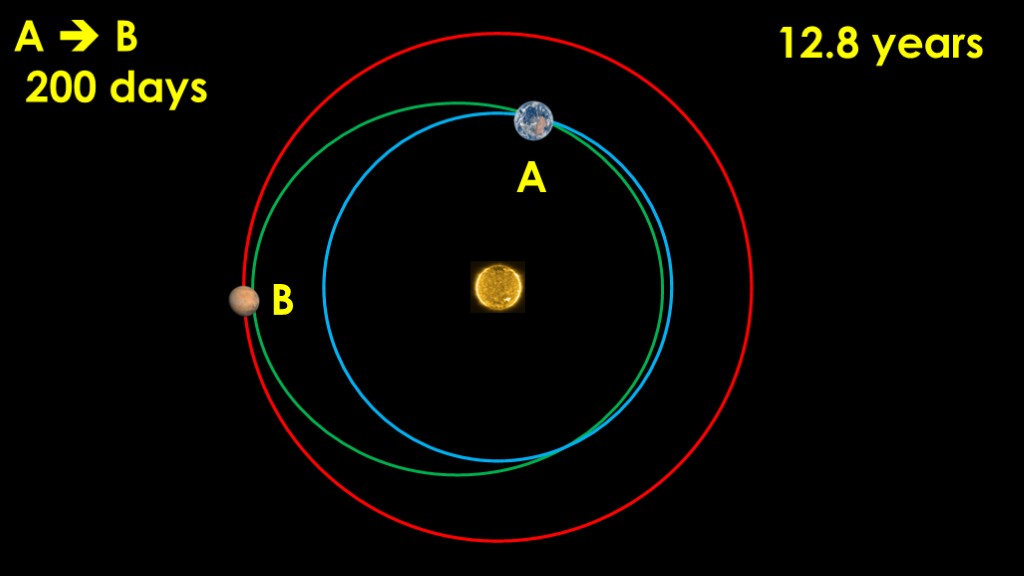
If you are shipping cargo, there's an interesting slow boat option.
The cycler known as 6S9 takes 200 days to get from earth to mars and repeats once every 12.8 years, but it requires very little delta v to get to Mars - pretty much the same as the non-cycler version - so it's cheap. If you want to send cargo back and forth, maybe you choose that cycler.
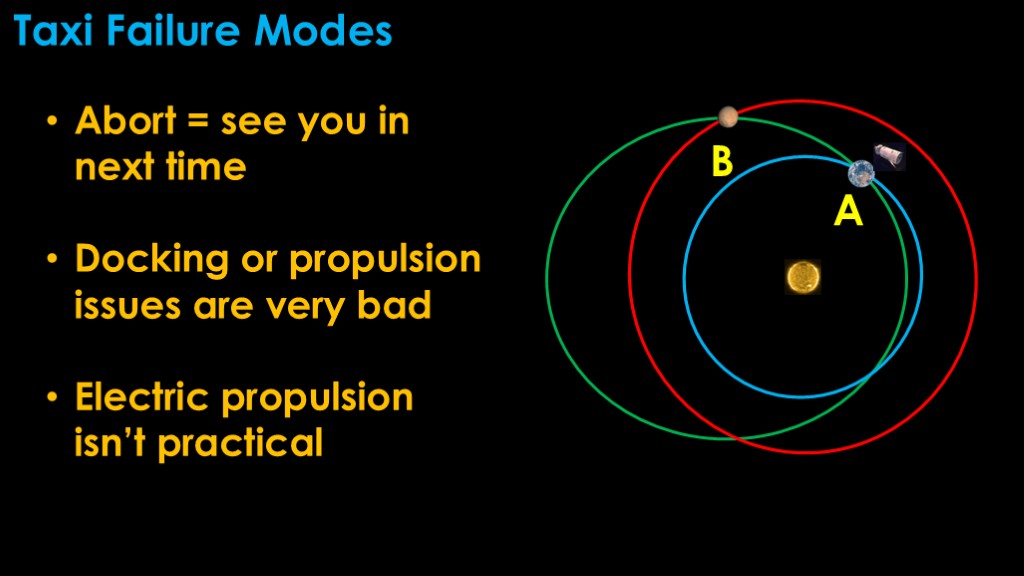
The taxi approach and docking architecture has some unfortunate failure modes.
There is an instantaneous launch window. If you have to abort, the only option is to wait for the next cycler, which takes 26 months unless there are multiple outbound cycler. Direct to mars approaches have a 20 to 30 day window.
If you rendezvous with the cycler but can't dock, you are stuck in your taxi for the whole trip to Mars. You maybe brought enough food and with you, but you may not have the equipment to provide breathable air for that long. You don't have exercise equipment or good radiation shielding. You will be spending 146 days in your taxi.
If you have propulsion issues and can't meet the cycle, you are stuck in your taxi and you aren't going to Mars. You might end up back at earth in months or years depending on the failure. The probability of survival is not great.
Electric propulsion isn't practical. The time between departure and meeting the cycler relies on quickly being able to match the cycler's speed, and current ion engines can't generate enough thrust to do that. They could slowly spiral out to reach the orbit of the cycler, but that will take months and therefore would not work for crewed flight.
These scenarios are major issues.
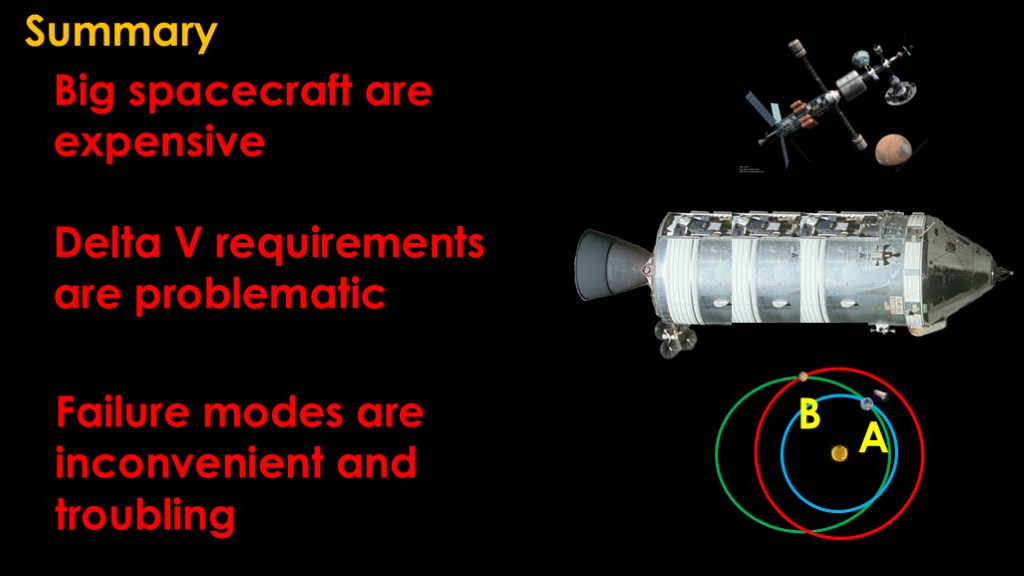
In summary:
Cyclers get you mars more quickly, but
Big cycler spacecraft are going to be very expensive to design and build and you won't build very many of them so they won't get much cheaper.
The delta v requirements for taxi vehicle are problematic. It's much harder to get to the cycler than going straight to Mars and the inability to use electric propulsion limits the architectural options.
The failure modes are inconvenient and troubling.
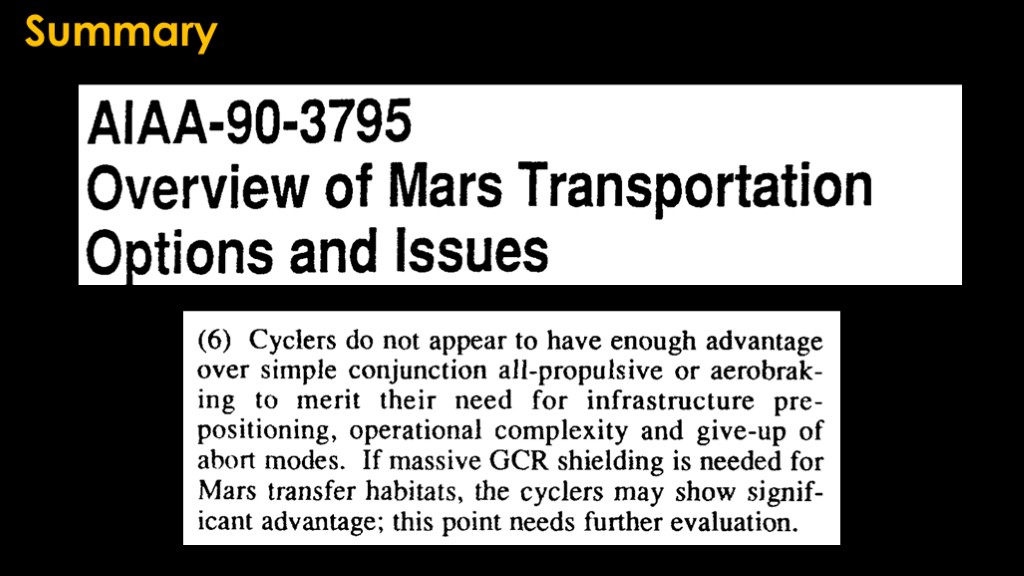
I'll leave you with this quote from a 1990 NASA overview of Mars transportation options:
(read) (GCR = galactic cosmic ray)
And that's all for cyclers.

Today's song is Stuck in a Loop by DEVO off their 1990 album "Smooth Noodle Maps"
https://www.youtube.com/watch?v=XKjFEa2xv4g